Overthinking feels responsible
Overthinking rarely presents itself as a problem. It presents itself as care.
You are just trying to make the right decision. You are just reviewing what happened. You are just preparing for every possible outcome so nothing catches you off guard.
That is why it is hard to stop. The loop borrows the language of responsibility.
But responsible thinking produces usable next steps. Overthinking produces more thinking.
The loop wants certainty
Most overthinking is a demand for certainty that the situation cannot provide.
Will they be upset? Will this work? Did I say it wrong? What if I choose badly? What if the thing I fear is already happening?
The mind keeps asking because it believes one more pass will make the future safe. Sometimes more information is useful. Often, the information is not available, and the search itself becomes the distress.
At that point, the next helpful move is not a better answer. It is a better question.
The practice: name, sort, choose
Try a three-step practice.
Name the loop in one sentence. "I am trying to know how this will turn out." "I am replaying a conversation to find certainty." "I am asking a question nobody can answer tonight."
Sort the issue into one of two columns: information available or information not available. If information is available, name the next source and the time you will check it. If it is not available, say that plainly.
Then choose one participation. Not the whole solution. One thing you can do that belongs to your side of the street.
This is simple enough to sound unimpressive, which is why it works. Overthinking wants a grand resolution. Practice returns you to a real action.
Your side of the street
Your side of the street includes your words, your calendar, your rest, your honesty, your request, your apology, your boundary, your effort, and your attention.
It does not include another person's private interpretation, a future outcome, or a perfect guarantee that nobody will misunderstand you.
When you move attention back to your side of the street, you are not giving up. You are returning to leverage.
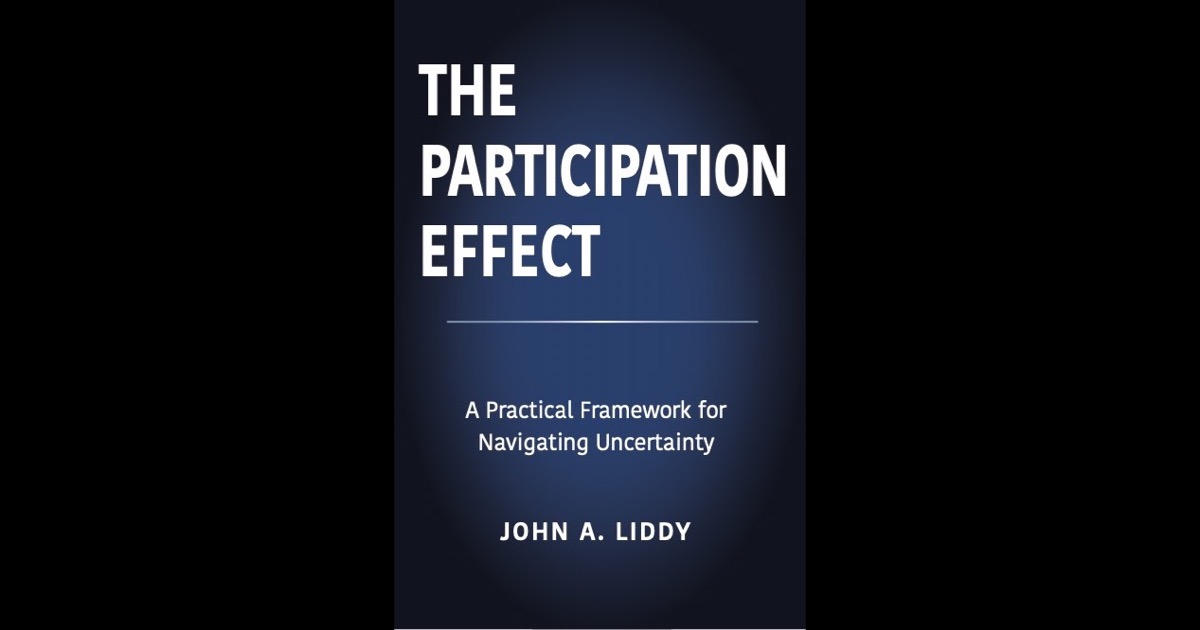
That is the heart of The Participation Effect: life changes through participation, not through endless private simulation.
Use a short timer
If the loop is loud, give it a container instead of pretending you can shut it off by command.
Set a ten-minute timer. Write the concern in plain language. List the available facts. List the unavailable facts. Choose the one next participation. When the timer ends, stop collecting arguments.
The stopping point is part of the practice. Without it, reflection becomes a hallway with no doors.
Repeat before it feels natural
The first few times, the mind may return to the loop immediately. That does not mean the practice failed. It means the loop is practiced and the interruption is new.
Do the small return again. Name, sort, choose. Then do the next thing in front of you.
You are teaching attention a new route. Routes are built by repetition.
If you want the full framework behind this practice, The Participation Effect is on Amazon. If you want a two-minute daily prompt for choosing your next participation, start with Daily Rise.