Let's get something out of the way: if the phrase "raise your frequency" makes your skin crawl, if you've ever closed a book the moment it told you to "trust the universe," if you find the entire self-help section of the bookstore physically repellent — this article (and the book behind it) was written specifically for you.
Not in the "oh, we welcome skeptics too!" way. In the "the author shares your exact allergy" way.
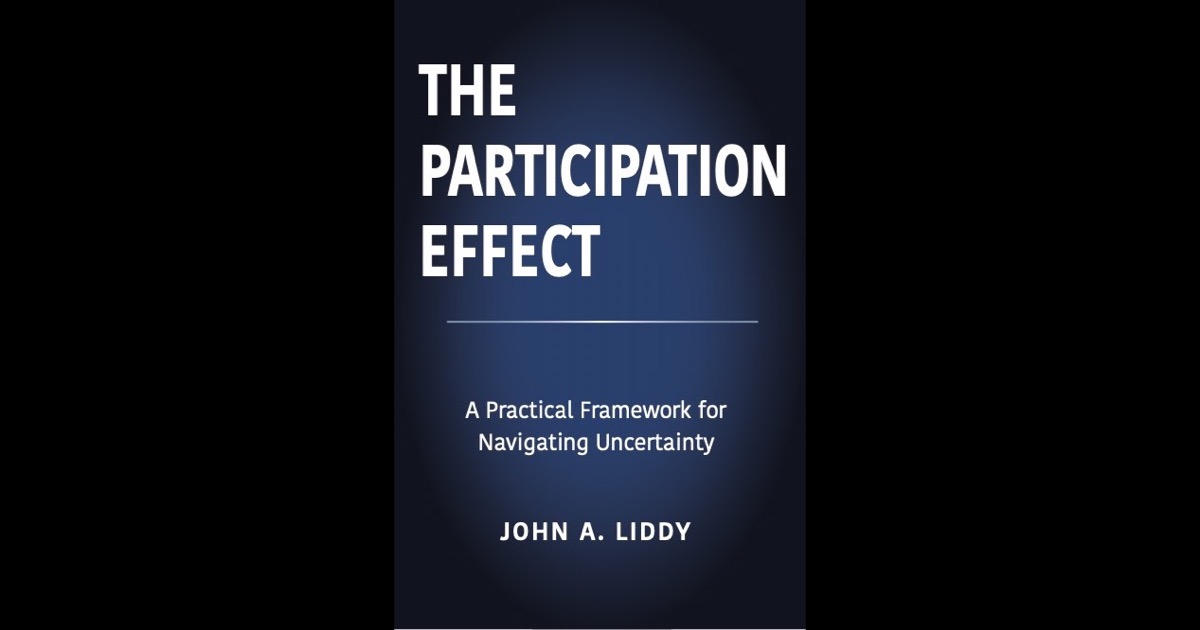
The Participation Effect by Dr. John A. Liddy bans the word that rhymes with "pan-a-fest" from its pages. It makes no promises about the cosmos delivering your dreams. It does not ask you to visualize a check in your mailbox. It is, as far as I can tell, the first self-help book that is openly hostile toward its own genre — and better for it.
Why Most Self-Help Books Fail Smart People
Here's the problem. You're stressed. Maybe genuinely struggling. You're not sleeping well, you're overthinking everything, your chest is tight by 9 AM and stays that way until you fall asleep at midnight. You know something needs to change.
So you pick up a book. And within three pages it's telling you that your thoughts create your reality, that you need to align your energy, that abundance is your birthright. And the rational part of your brain — the part that got you through school, that helps you do your job, that you actually trust — says: this is nonsense.
So you put the book down. And nothing changes.
The tragedy isn't that self-help doesn't work. It's that the packaging is so bad that the people who need practical tools the most are the ones who can't get past the language. The mystical wrapping repels exactly the audience that would benefit from what's inside — if someone would just strip it out.
That's what this book does.
A Framework, Not a Philosophy
The core claim of The Participation Effect fits on an index card: emotional regulation improves your participation inside uncertain systems.
That's it. No cosmic mechanics. No appeals to forces science can't measure. Just a straightforward observation: when you're calmer, you see more clearly. When you see more clearly, you recognize more options. When you have more options, you make better decisions. When you make better decisions, your outcomes tend to improve over time.
The chain looks like this:
- Stress narrows perception
- Narrowed perception = fewer visible options
- Fewer options = worse decisions
- Worse decisions = worse outcomes
Reverse it:
- Emotional regulation widens perception
- Wider perception = more recognized options
- More options = better decisions
- Better decisions = better probability trajectory
Notice the language. Not "better destiny." Not "aligned frequency." Better probability trajectory. This is a book that respects your intelligence.
The Story That Makes It Click
Dr. Liddy is a chiropractor, not a guru. He spent ten years living in financial fear — gripping everything, scanning for threats, catastrophizing about bills that hadn't come due yet. His wife, living in the same house with the same bank account, would point out a sunset. He couldn't see it. Same sky. Same eyes. Completely different experience.
The difference wasn't circumstance. It was the filter.
His stress had narrowed his perception so severely that beauty, opportunity, and even basic contentment were invisible to him. Not metaphorically invisible. Functionally invisible — the way you can't read a street sign when your vision is blurred. The information is there. You just can't process it.
That's not mysticism. That's how stressed brains actually work. Cortisol narrows attentional focus. Threat detection overrides exploratory thinking. This is established neuroscience dressed in readable language — which is exactly what makes the book useful instead of merely accurate.
The Honesty That Earns Trust
Here's where most self-help books lose credible people: they overpromise. They imply that the right mindset can fix anything. Lost your job? Think positive. Chronic illness? Gratitude journal. Grief? Well, you must be resisting the flow.
The Participation Effect draws a hard line that most books in this space don't have the courage to draw. It distinguishes between two kinds of suffering:
Resistance-based suffering — the catastrophe loops, the fear of futures that haven't happened, the 3 AM spirals about things that may never occur. This is the suffering you generate by gripping. The book can help with this. Substantially.
Life-based suffering — real loss, genuine grief, serious illness, the death of someone you love. The book is honest about this in a way that actually startled me:
"Pretending this practice can dissolve it is a lie I won't tell you."
That single sentence does more to build credibility than a hundred five-star reviews. It says: I'm not going to insult your intelligence. I'm not going to pretend I have a tool for everything. Some pain is just pain, and honoring that is more respectful than offering a fix.
Practical Tools, Not Spiritual Homework
The book introduces an emotional scale — a way to check in with yourself and notice where you are. But it's careful about framing. Being at a low level isn't a moral failing. It's not something you did wrong. The book's language for this is precise: "It's weather, not character."
You wouldn't beat yourself up for rain. You'd grab an umbrella. The emotional scale works the same way — it's a reading, not a report card.
And the "compound effect" the book describes is deliberately stripped of magical thinking. It's not "think happy thoughts and good things appear." It's this: a different emotional baseline, practiced consistently, produces a different perceptual filter. A different filter means different choices. Different choices, compounded over months and years, produce a measurably different life.
Dr. Liddy describes the moment it clicked for him — driving to work on an ordinary Tuesday, just feeling good for no particular reason, after two years of practice. No lightning bolt. No awakening. Just the quiet absence of the dread that had been his constant companion for a decade. The ordinariness of the moment is what makes it believable.
The Companion App (That Takes Two Minutes)
The book comes with a free companion app called Daily Rise. It's a two-minute emotional check-in. Not a meditation timer. Not a gratitude prompt. Not a vision board. Just: where are you right now, emotionally? That's it.
The theory is simple — awareness precedes change. You can't regulate what you don't notice. Two minutes of honest self-assessment, done consistently, starts to build the pattern recognition that the book's framework depends on.
It's the least annoying self-help app I've encountered, mostly because it asks almost nothing of you.
Who This Book Is Actually For
This book is for the person who knows they're stuck but can't stomach the typical prescription. The overthinker who has tried meditation and spent the whole time making grocery lists. The high-performer whose stress is "working" in the sense that it drives output, but is quietly corroding everything else. The person in recovery who needs emotional tools that don't require adopting a new belief system. The partner or parent who is tired of reacting to everything at a 9 out of 10.
It's for anyone who has ever thought: I know I'd benefit from this stuff if it weren't so embarrassing.
The Participation Effect removes the embarrassment. What's left is a clear, honest, genuinely useful framework for managing how you feel so you can improve how you participate in your own life. No crystals. No chanting. No promises the universe is listening.
Just better tools for navigating uncertainty — which, last time I checked, is most of what life actually is.
Ready to read it for yourself?
The Participation Effect is available now on Amazon. The Daily Rise companion app is free.