You know the feeling. You open an email and your stomach drops. You replay a conversation for the fourteenth time. You lie in bed constructing elaborate futures that haven't happened — and probably won't. You tell yourself to stop. It doesn't work. You try harder to stop. It gets worse.
Here's the thing nobody tells you about overthinking: it's not a personality flaw. It's not because you're "too sensitive" or "too analytical" or need to "just relax." Overthinking is a predictable, mechanical process — and once you understand why it happens, you can interrupt it in about two minutes.
Your Brain Isn't Broken. It's Narrowed.
When you're calm, your perception is wide. You notice options. You see nuance. You can hold two contradictory ideas without your nervous system catching fire.
When you're stressed, that wide-angle lens collapses into a telephoto. Suddenly, everything is threat. Everything is urgent. Everything requires a decision right now.
"Emotion narrows or widens perception. When you're anxious, you scan for threat."
— The Participation Effect
This isn't philosophy. It's how your nervous system actually works. Stress hormones shift your attention toward danger and away from possibility. You don't overthink because something is wrong with you. You overthink because your body is doing exactly what it was designed to do — scanning for threats — except now the "threat" is an email from your landlord, not a predator in the tall grass.
The Party You're Not At
Picture two people walking into the same party. Same room, same music, same people.
Person A just got a promotion. They feel good. They notice the friend waving from across the room, the good song playing, the open seat at the bar. The party is great.
Person B just had a fight with their partner. They feel raw. They notice the person who didn't say hi, the group laughing (probably about them), the fact that the music is too loud. The party is terrible.
Same party. Completely different experience. The difference isn't the room — it's the filter each person is carrying into it.
When you're stressed, your filter narrows to threats only. You stop noticing what's neutral or good. And because your perception feeds your thoughts, you start generating more anxious thoughts, which narrow your perception further, which generates more anxious thoughts. That loop is what we call overthinking.
It's not random. It's not mysterious. It's a feedback cycle, and it has a structure you can interrupt.
Ninety Seconds to Career Ruin (That Never Happened)
Here's a story from the book that might sound familiar — not because you've been through the same situation, but because you've been through the same process.
Dr. John Liddy opens an email. There's been water damage at one of his properties. The email is aggressive. Threatening. Within ninety seconds, his mind has built an entire future: insurance won't cover it, the tenant will sue, his finances will collapse, his career is over.
"I hadn't left my chair. I hadn't seen the damage. But in my mind, the verdict was already in."
— The Participation Effect
Ninety seconds. That's all it took to go from "I got an email" to "my life is ruined." And every bit of that catastrophe was constructed by a mind operating in threat mode — not reality.
He catches himself at a gas station. He stops. He breathes. He asks one question: "What has actually occurred?"
The answer: he got an email. That's it. The email described potential damage. He hadn't inspected anything. He hadn't talked to anyone. He had no evidence. Just a nervous system on fire and a mind filling in the blanks with the worst possible outcomes.
Once he asked the question — what has actually occurred — the catastrophe shrank to something manageable. Not gone. Just right-sized.
That's the move. Not positive thinking. Not pretending you're fine. Just pulling back from the story your mind is telling you long enough to ask: what is actually true right now?
Your Body Knows Before You Do
Here's a piece most overthinking advice misses entirely: physiology precedes cognition. Your heart rate rises before you form the anxious thought. Your shoulders tighten before you start the mental loop. Your body is already reacting while your conscious mind is still loading the narrative.
This matters because it means you can't think your way out of overthinking. The signal started in your body, and that's where the interrupt needs to happen too.
The book lays out a five-step sequence for working with this:
- Notice Catch the physical signal — tight chest, shallow breathing, clenched jaw
- Identify Check your altitude: where are you on a 1-10 emotional scale right now?
- Apply Use a regulation tool matched to your state — breathwork, grounding, movement
- Reassess Check your physiology again. Has anything shifted?
- Decide Now — and only now — choose your behavior
"Most people reverse steps four and five."
— The Participation Effect
They decide and act while still flooded, then wonder why they sent that text, made that call, or spiraled at 2 a.m. They skipped the reassessment. They acted from the narrowed state, not the regulated one.
The 2-Minute Fix: The Daily Rise
This is the practical core. It's called the Daily Rise, and it takes about two minutes. No app required (though there is one if you want it). No special training. Just five steps you can do anywhere — at your desk, in your car, in a bathroom stall before a meeting.
- Arrive. One breath. You're not trying to relax. You're just landing in the present moment. Feel your feet on the floor.
- Check in. Where are you on a 1-10 scale? Don't judge it. A 3 is data, not a verdict. A 7 is data too.
- Process. Do one thing matched to your state. If you're low (1-3), try grounding — cold water on your wrists, naming five things you can see. If you're mid-range (4-6), try box breathing. If you're higher, you might just need to notice and name what you're feeling.
- Check out. Where are you now? Same number? Different? No wrong answer.
- See the shift. Did anything move, even by half a point? That's the data. That's the proof your state isn't fixed.
That's it. No journaling required. No affirmations. No pretending you feel great when you don't. You just check in, try something small, and see if anything shifts.
The power isn't in any single session. It's in the repetition. You're training your nervous system to recognize that emotional states are not permanent — that you have some say in how you feel, even when life is hard.
Face the Worst Case. Find It Survivable.
Overthinking runs on fuel, and that fuel is the unexamined worst case. As long as the catastrophe stays vague and looming, it has power over you. The moment you look at it directly, something shifts.
The book calls this the acceptance bridge. You face the worst-case scenario — not to torture yourself, but to ask a single question: could I survive that?
Almost always, the answer is yes. Not "it would be fun." Not "it would be easy." Just: survivable. And that recognition — that the worst thing you can imagine is something you could endure — releases the grip.
From that place of acceptance, you're no longer operating from panic. You're operating from clarity. And from clarity, action becomes possible. Not reactive, desperate action. Considered, intentional participation in what comes next.
Why It Feels Like Nothing Is Working (Until It Does)
If you try the Daily Rise for a week and feel like nothing has changed, that's normal. You're not doing it wrong.
"Invisible, invisible, invisible — then suddenly obvious."
— The Participation Effect
This is the compound effect applied to emotional regulation. You don't notice each individual deposit. The daily two-minute check-in feels small — too small. You wonder if it's working. You consider quitting. Then one day you're in a situation that would have sent you spiraling three months ago, and you notice something different: you caught the signal. You paused. You asked what had actually occurred. And the spiral didn't start.
That's not luck. That's the accumulated effect of all those invisible reps. The practice didn't suddenly start working — it was working the whole time. You just couldn't see it until you needed it.
Overthinking Is Not the Problem. It's the Symptom.
The real problem is a nervous system stuck in threat mode, narrowing your perception, running the same loops, and convincing you that the only responsible thing to do is think harder.
You don't fix it by thinking harder. You fix it by interrupting the physical loop, widening your perception back out, and giving yourself enough clarity to ask: what has actually occurred?
Two minutes. That's the entry point. Not the whole journey — just the start. And it's available to you right now.
Ready to Break the Loop?
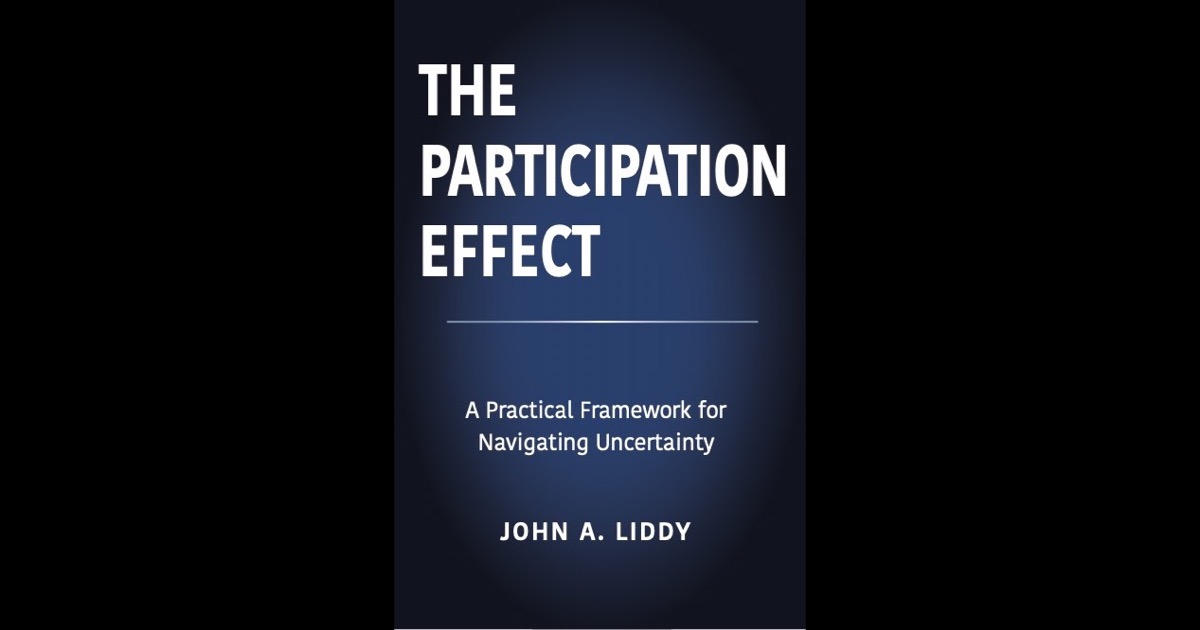
The Participation Effect gives you the complete framework — the emotional scale, the coping tools, the acceptance bridge, and the daily practice that makes it stick. The companion app is free.